


Backgammon Galaxy: Play Online
Backgammon Galaxy
I enjoy backgammon most when a game gives me enough room to think without turning every move into a long ceremony. Backgammon Galaxy takes that approach with a focused online board, live opponents, artificial-intelligence analysis, learning tools, and ranked play. It is a free board game from Backgammon Galaxy for Android, aimed at Everyone, and it feels designed for players who want to improve rather than simply pass a few minutes with a casual puzzle.
My first impression is that the app works best when I treat it as a repeatable practice routine. I can play a quick match, review the decisions that bothered me, and return later with a clearer idea of what I want to fix. That makes it more useful than a basic digital backgammon board, although it also means the experience can feel demanding if I only want a relaxed game against a friend.
How I use the game from the first move to the post-game review
The most practical workflow starts with a clear purpose. If I am playing live online, I focus on board reading, clock awareness, and making a sound decision with incomplete information. If I am using the AI analysis, I slow down and look for the reason behind a better move instead of treating the recommendation as an answer key. Mixing those two modes in the same session can be useful, but only if I remember that fast competition and careful study require different habits.
Before starting a match, I take a moment to identify the type of session I want. A short game is suitable when I want to test whether I am seeing basic risks correctly. A longer study session is better when I am trying to understand cube decisions, timing, or the difference between an attractive move and a safe one. The app’s value increases when I decide this in advance, because otherwise I can drift from competitive play into analysis without learning much from either.
The live online format gives each move a little more weight than playing alone against a predictable computer opponent. I have to read the position, estimate what the other player is likely to do, and accept that a good decision can still produce an unlucky result. That is an important part of backgammon, and the online setting makes the lesson more immediate. It also means the game is not ideal when my internet connection is unreliable or when I need a completely interruption-free activity.
Related News






After a match, I find the analysis tools most helpful when I review only a few turning points. Looking at every move can become passive: I watch the AI explain the game, nod, and then forget the lesson. Instead, I mark the positions where I felt uncertain, where I played quickly, or where the result changed direction. I then compare my choice with the suggested alternative and ask what feature I missed, such as a vulnerable blot, a race issue, or a poor distribution of builders.
This creates a useful loop: play, identify uncertainty, study the position, and deliberately watch for the same pattern in the next match. It is more effective than repeatedly starting new games without reflection. The app does not need to replace a book, a coach, or a local club for this workflow to work; it can serve as a convenient practice board that connects real play with immediate review.
What the free version means in everyday use
The game is free to download, which makes it easy to try before deciding whether it fits my routine. It includes optional in-app purchases ranging from $0.99 to $249.99 per item, so I would approach the purchase screen carefully and avoid assuming that every useful part of the experience is included without cost. For a new player, the sensible approach is to play first, learn the basic interface, and decide later whether any optional purchase genuinely supports the way they use the app.
Gallery
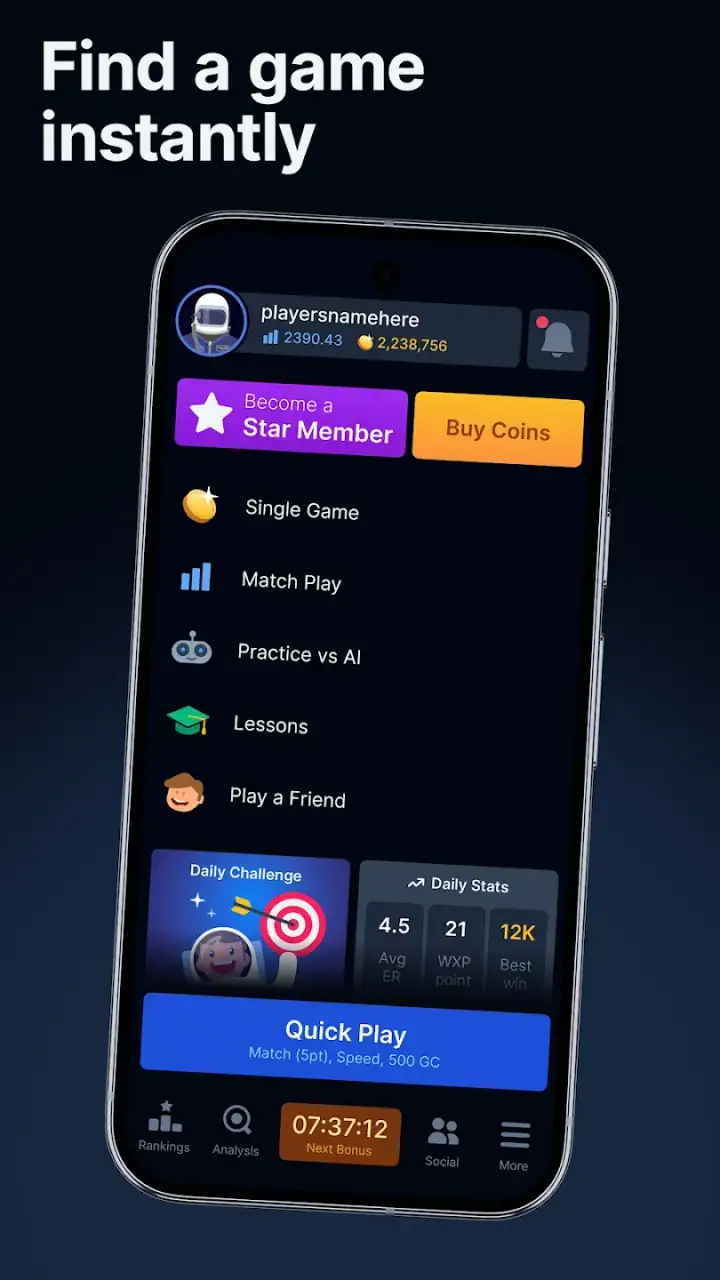
Its audience is broad because the age rating is Everyone, but the competitive design gives it a more serious feel than that label might suggest. A beginner can enter with only a basic knowledge of the rules, while an experienced player can use the ranked environment and analysis to sharpen decisions. The difference is that beginners may need patience: the board can show them what happened, but understanding why a move was weak still requires active thinking.
The app has reached over 100 thousand installs and holds an average rating of 4.1 from around 3.6 thousand ratings, with close to 200 written reviews. Those figures suggest a substantial enough player base to make the online concept meaningful, while also showing that it is not universally loved. I would read the rating as a sign of a solid but specialized game rather than a guarantee that every player will enjoy its pace or competitive focus.
Settings and small habits worth checking
I recommend checking the available game and analysis settings before settling into ranked play. The important question is not whether every option is enabled, but whether the presentation helps me make decisions cleanly. I want the board to be easy to read, the move process to feel deliberate, and analysis to remain something I choose rather than background noise that distracts from live play.
A useful habit is separating learning sessions from rating-focused sessions. During learning, I can pause mentally before moving, consider more than one candidate play, and use the AI afterward. During a ranked match, I should avoid trying to reconstruct every analytical detail while the clock is moving. This separation protects the quality of both activities and prevents me from playing slowly without actually thinking better.
I also pay attention to how quickly I confirm moves. A fast tap may be convenient, but it can turn a moment of uncertainty into an accidental commitment. When I am studying, I prefer a deliberate rhythm: inspect the whole board, identify the immediate threat, consider the likely reply, and only then complete the move. This is not a special trick hidden in the app; it is a simple way to use a digital interface without letting it rush my judgment.
Another practical check is whether I am comfortable with the way the application presents feedback. AI analysis is powerful because it can reveal mistakes that feel invisible during play, but it can also be discouraging when I look only at the evaluation. I get more from it when I translate a recommendation into a human rule. For example, instead of remembering one exact move, I might note that I was too eager to hit when maintaining a stronger board would have preserved my advantage.
The current version is 6.0.109, and the game supports Android 7.0 or later. That makes it accessible on a wide range of compatible Android devices, but I would still judge the experience by practical comfort: board visibility, touch accuracy, and whether the phone handles live play smoothly. Backgammon does not need spectacular graphics, so a clear board and dependable input matter more to me than visual effects.
Faster patterns that improve play without making it careless
Experienced use is less about finding a shortcut that removes thinking and more about building a consistent scan. I begin by checking immediate hits and forced responses, then look at the opponent’s home board, the safety of my own checkers, and the race if contact is limited. This order helps me avoid a common mistake: spotting an attractive attacking move before noticing that it leaves a more serious weakness elsewhere.
When I play several games in one sitting, I use the same scan every time. Repetition reduces the chance that excitement or frustration will control the next decision. The benefit is especially noticeable after a bad roll. Instead of reacting emotionally, I return to the same questions and judge the position that is actually on the board. That makes the app’s competitive environment feel more like training and less like a sequence of isolated wins and losses.
I also separate dice luck from decision quality. A lost game can contain excellent choices, and a win can hide a move that I should not repeat. The analysis feature is most valuable here because it gives me a way to challenge my first impression. If I won after taking a risky line, I still want to know whether the move was sound. If I lost after playing carefully, I want to know whether the position was genuinely difficult or whether I missed a straightforward improvement.
For short daily sessions, I would choose one theme rather than attempting to improve everything. One day might focus on avoiding loose blots; another might focus on recognizing when a race has become more important than contact. After the game, I write down one sentence about the mistake I want to notice next time. That small record turns the app into a personal training tool and prevents analysis from becoming entertainment disguised as study.
There is also a useful trade-off between live opponents and AI review. Human play exposes me to varied decisions and time pressure, while analysis gives me a stable way to inspect positions. If I use only the AI, I may become comfortable with perfect explanations but less comfortable making choices against another person. If I use only live play, I may repeat the same errors because the result distracts me from the decision. Combining both is the strongest routine I found.
Where the advanced experience reaches its limits
The app is not the right choice for everyone. Someone looking for a purely social board game with a friend beside them may prefer a simpler local-play alternative. A player who dislikes rankings, live competition, or post-game evaluation may find the serious atmosphere unnecessary. Likewise, anyone who wants a broad collection of unrelated board games will get more variety from a general board-game app than from this specialized backgammon experience.
Beginners should also understand the difference between access and mastery. The rules are approachable, but strong backgammon decisions involve probability, timing, risk management, and reading future positions. The AI can point toward a stronger play, yet it does not automatically build intuition. I would not recommend blindly copying every suggestion. The better question is why the move works and what visual clue should alert me to a similar position later.
Ranked play adds motivation, but it can also distort the learning process. When I care too much about the result, I may choose a familiar move instead of exploring a difficult but instructive option. I may also play too quickly after a lucky sequence because I feel confident. A disciplined player treats ranking as a measure of competitive performance, not as a complete measure of understanding.
Purchases are another reason to keep expectations realistic. Since optional items can range from a small amount to a much larger amount, I would not spend simply because I am losing or because I want faster progress. First I would confirm that the basic workflow suits me, then decide whether an optional item has a clear purpose. If I cannot explain what it changes for my own practice, keeping the money is the better choice.
The online format can also expose a limitation that has nothing to do with the quality of the board: availability depends on other players and on the connection. A local board or an offline-focused alternative may be better for travel, weak connectivity, or a quiet family game. Backgammon Galaxy is strongest when I want an active online environment and can give the match my attention.
Who will get the most from it
I would recommend it to a player who already knows the basic rules and wants a structured way to play more often. It is particularly suitable for someone who enjoys reviewing mistakes, competing against live opponents, and gradually building a repeatable decision process. The combination of online matches and AI analysis gives that player a reason to return beyond simply collecting wins.
It can also suit a beginner who is comfortable learning by doing. I would suggest starting with unpressured games, reviewing only the clearest mistakes, and resisting the urge to chase a ranking immediately. The first goal should be recognizing the board’s recurring patterns. Once those become familiar, the competitive side becomes less overwhelming and more rewarding.
For an everyday scenario, imagine having a short break after work. I would play one focused match rather than opening the app without a plan. Afterward, I would revisit one position where I hesitated, identify the alternative, and carry one lesson into the next session. That routine fits the game better than marathon sessions, because concentration fades and repeated losses can make analysis emotional instead of useful.
Compared with a traditional physical board, the app offers convenience, immediate opponents, and analytical feedback, but it loses some of the social warmth of sitting across from another person. Compared with a basic offline computer game, it offers more competitive pressure and a more meaningful review habit, but it may feel less relaxing. Compared with a general board-game collection, it sacrifices variety in exchange for a deeper focus on one game.
My verdict after building a repeatable routine
Backgammon Galaxy works best as a practice-centered online backgammon game, not as a decorative time-killer. I like that it gives me a path from live play to reflection: make a decision, see the result, inspect the important moments, and try to recognize the same situation later. That loop is the app’s strongest quality, especially for players who enjoy improving through repeated habits.
Its limitations are clear as well. The competitive environment may be too intense for someone seeking a casual local game, AI feedback can be misunderstood if treated as an unquestionable answer, and optional purchases deserve careful consideration. The game also asks me to bring patience; simply playing more matches does not guarantee improvement unless I review the decisions that mattered.
With a free entry point, an Everyone rating, support for Android 7.0 and later, and a current version of 6.0.109, it is easy for compatible Android users to test the basic experience. I would start without spending, establish a simple scan for every position, and use analysis on a small number of meaningful moments. For me, that makes this a worthwhile recommendation to serious learners and regular online players, while casual users may be happier with a simpler board or a face-to-face game.
FAQs for Backgammon Galaxy: Play Online
What is Backgammon Galaxy: Play Online?
Backgammon Galaxy: Play Online is a digital backgammon platform designed for players who enjoy competitive matches against real opponents. It focuses on the classic rules of backgammon while adding online matchmaking, rating-based competition, and game analysis features. The interface is generally clean and easy to understand, making it suitable for both experienced players and newcomers learning the fundamentals.
Can I play Backgammon Galaxy offline or without creating an account?
The main appeal of Backgammon Galaxy is its online multiplayer experience, so a stable internet connection is normally required for competitive matches, matchmaking, rankings, and other connected features. Some versions or modes may offer limited practice options, but users should not expect a complete offline game. Account requirements can also vary depending on the platform and the features they want to access.
Is Backgammon Galaxy suitable for beginners?
Yes, beginners can use Backgammon Galaxy to learn and improve, although the competitive environment may feel demanding at first. The basic rules are simple to understand, but successful play requires strategy, probability awareness, and careful decision-making. New players should take time to learn legal moves, doubling-cube mechanics, and common tactics before focusing heavily on ratings or challenging stronger opponents.
Does Backgammon Galaxy include rankings, tournaments, or competitive features?
Backgammon Galaxy is built around competitive online play and typically includes systems that help players face opponents of a similar level. Depending on the current version, users may find ratings, leaderboards, leagues, tournaments, or other organized events. These features add long-term motivation, but they can also make matches feel intense, especially when a player is concerned about maintaining a ranking or winning streak.
Is Backgammon Galaxy free to download, and are there in-app purchases?
The application may be available to download without an upfront charge, but availability, account features, advertisements, and optional purchases can differ between Android and iOS. Before installing, users should check the official store listing for the latest pricing information and subscription details. It is also worth reviewing the app’s permissions and purchase policies if children or shared devices will be using the game.
Pros
- Clean
- modern interface that keeps the board easy to read.
- Strong online matchmaking for quick games against real opponents.
- Multiple time controls suit both casual and competitive players.
- Helpful move analysis supports learning from mistakes after each game.
- Cross-platform play lets you compete with a broad player community.
Cons
- Connection issues can interrupt matches and affect the playing experience.
- The competitive rating system may feel intimidating for new players.
- Some advanced analysis or features may require a paid subscription.
- Matchmaking quality can vary depending on your skill level and region.
- Limited offline functionality compared with traditional backgammon apps.


